

 Share
Share DHA Pharmacist Exam (Dubai): Complete 2025 Guide
What Is the Exam?
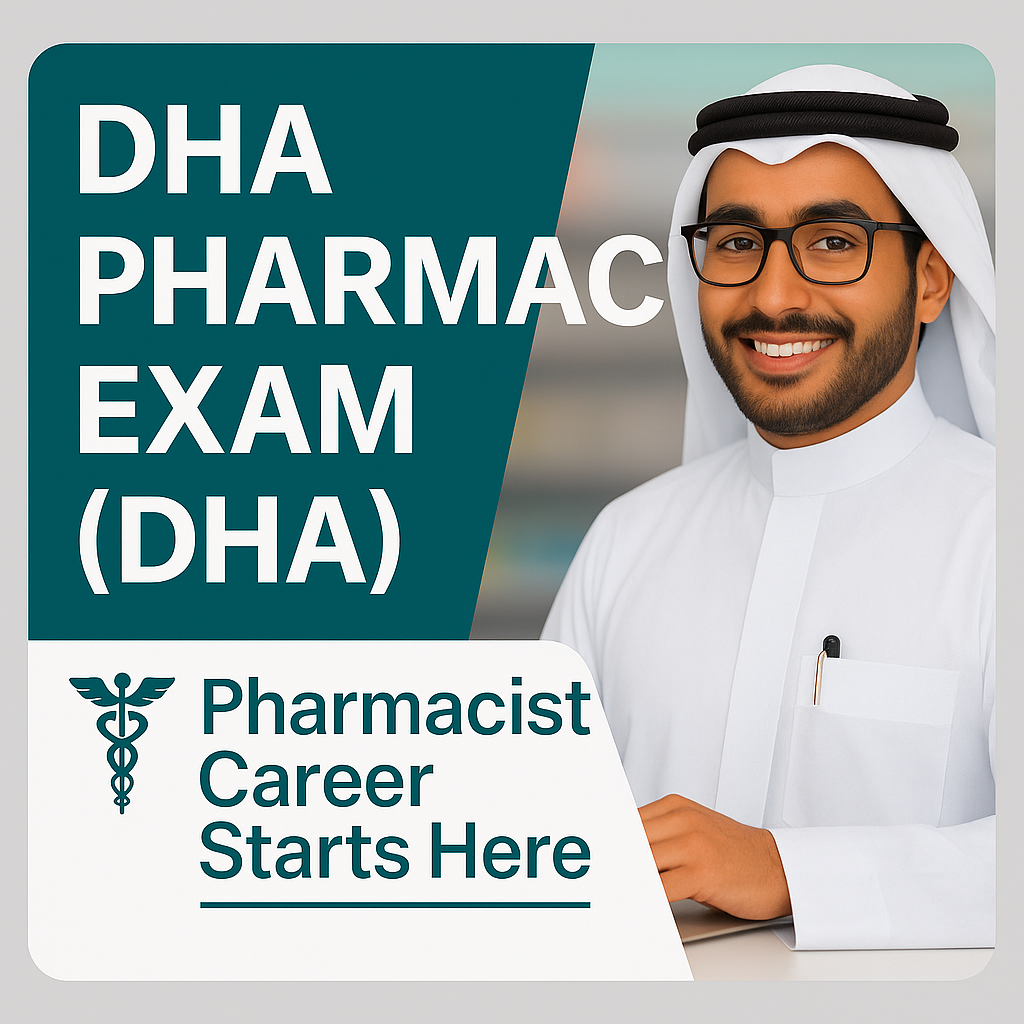
The DHA pharmacist exam is a professional licensure test that verifies a pharmacist’s clinical and professional competence to practice within the Emirate of Dubai. It is delivered as a computer-based test through an approved testing provider at centers inside the UAE and abroad. Results are posted in the candidate’s account as Pass/Fail. The goal is to ensure readiness for practice before a license is issued.
Correct Step-by-Step Sequence
-
Create an account on the authority’s system, choose the pharmacist pathway, and complete your profile according to the category requirements.
-
Complete professional registration or classification for pharmacists and review category conditions, using self-assessment if needed.
-
Complete Primary Source Verification (PSV/DataFlow) for qualifications and experience.
-
After approval, an eligibility to schedule is issued.
-
Schedule the computer-based exam and select your city, test center, and date.
-
Sit the exam and wait for the result to be uploaded to your account—typically within two business days.
Important note: The statement “DataFlow before or after passing” is inaccurate; DataFlow is an essential part of the licensure process and is required before eligibility and scheduling.
Exam Details
-
Question type: Multiple Choice Questions (MCQs).
-
Question count and duration: Commonly around 150 MCQs with a total time of about 165 minutes; some windows may list 3 hours depending on the notice.
-
Language: English, using professional pharmacy terminology.
-
Result format: Pass/Fail in the account, with no universally announced pass percentage for all categories.
-
Result upload time: Typically within two business days after the CBT session.
Required Documents for Pharmacists
-
Bachelor of Pharmacy (BPharm) or Doctor of Pharmacy (PharmD).
-
Internship or professional training certificate, if applicable.
-
Academic transcript.
-
Practice license or letters of good standing and experience, if applicable.
-
UAE ID or valid residence permit, or a valid passport.
-
Completed PSV/DataFlow as required.
Tip: Ensure your name and validity dates match across all documents to avoid verification and scheduling delays.
What to Study
Divide your study time into three main tracks, with an emphasis on patient safety and error reduction.
Track 1: Clinical Therapeutics
Common conditions (cardiovascular, respiratory, diabetes, renal, hepatic, infectious diseases), plus women’s/children’s health and geriatrics. Focus on counseling, drug–drug interactions, clinical calculations, and dose adjustments in renal/hepatic impairment, pregnancy, and the elderly.
Track 2: Pharmaceutical Sciences
Pharmacology and toxicology, pharmaceutics and pharmacokinetics, medicinal chemistry and structure–activity relationships, dosage forms and stability, herbals and supplements.
Track 3: Professional Skills
Dispensing and medication safety, documentation, inventory and supply chain, fundamentals of quality and ethics of practice.
Compact action plan:
-
Timed MCQ practice sessions (50–75 questions each) with a daily error log.
-
A 24-hour review of weak areas after every session.
-
A focused three-day pre-exam plan on interactions, dose adjustments, and high-priority adverse effects.
Exam Day
-
Bring a valid ID and a printed appointment confirmation.
-
Arrive early and follow security procedures; lockers are available.
-
The exam is audio/video proctored—report any technical issue immediately to test-center staff.
-
Manage breaks within the overall exam time.
Common Test Centers in Egypt (Example)
-
Giza, Dokki, Mohie El-Din Abou El-Ezz Street.
-
Alexandria, Azarita, Pharaana Street, at the American Center or AMIDEAST.
Appointment availability appears only after you enter your eligibility details in the scheduling system.
FAQs
Do I need DataFlow before booking?
Yes. Primary Source Verification is required before eligibility and scheduling.
Is the pass mark sixty percent?
Sixty percent is a common preparation benchmark; the official outcome is Pass/Fail in your account.
When are results posted?
Typically within two business days after the exam; timing may vary by window.
Can I test in my home country?
Yes. You can choose a center from the provider’s global network during scheduling, subject to availability.
Are retakes allowed?
The number of attempts and rules are set by the authority’s policy for the given year; check your notice before planning a retake.

Share on social media



Blog categories
- NHRA Bahrain Pharmacist Exam (1) Egyptian Pharmacists’ Guide to Gulf Licensure (2)Qatar MOH / QCHP Pharmacist Exam (1)Oman Ministry of Health Pharmacist Exam (2)Kuwait Ministry of Health Pharmacist Exam (1)UAE Ministry of Health Pharmacist Exam (MOH) (1)Department of Health Abu Dhabi Pharmacist Exam (DOH/HAAD) (1)Dubai Health Authority Pharmacist Exam (DHA) (1)Saudi Pharmacist Licensure Exam (SPLE) – SCFHS (2)
Recent post
OMSB Pharmacist Exam in Oman 2026: Complete Registration, Booking, and Preparation Guide
June 29, 2026
How to Pass the SPLE Exam in Saudi Arabia: Complete Guide for Pharmacists (2026)
June 29, 2026
UAE Pharmacy Licenses Compared: DHA vs MOH vs DOH؟
January 7, 2026
Egypt Graduates — Your Roadmap to Working as a Pharmacist in the Gulf (2025 Guide)
September 18, 2025
Kuwait Pharmacist Exam & License | Practical Guide 2025
September 18, 2025
Bahrain NHRA Prometric Pharmacist Exam: Verified 2025 Guide
September 18, 2025
Oman Prometric Pharmacist Exam (OMSB): Verified 2025 Guide
September 18, 2025
Qatar Prometric Pharmacist Exam: Verified 2025 Guide
September 18, 2025
UAE MOH Pharmacist Exam: Complete 2025 Guide
September 18, 2025